The Palmyra Restoration Experiment
We tracked five coral restoration strategies across a decade of annual surveys โ right through the 2023โ2024 global coral bleaching event.
โ
Palmyra Atoll is an uninhabited coral reef ~1,000 miles south of Hawaii, established as a National Wildlife Refuge in 2001. It is one of the most well-managed reef ecosystems on Earth.
This disturbed the environment, and leached iron and nutrients into the surrounding water, corresponding with a mass outbreak of the invasive corallimorph Rhodactis howesii.
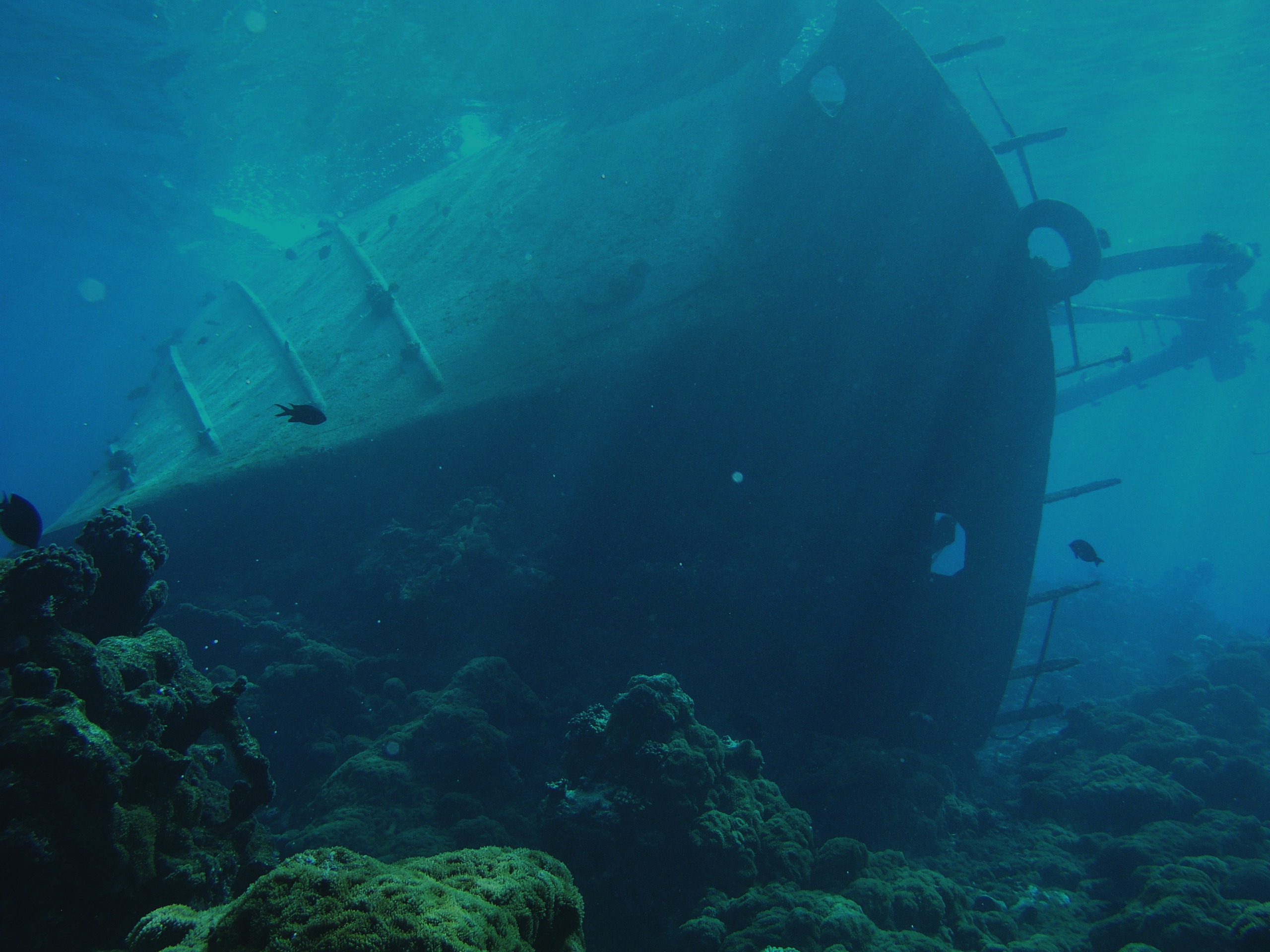
Corallimorphs are fast-growing, adaptable cnidarians that can outcompete hard corals and crustose coralline algae (CCA), fundamentally restructuring the benthic community.
This created a unique opportunity to implement experimental restoration strategies on a remote, well-managed reef.
Fifteen 3ร3 m permanent survey plots were established around the shipwreck scar and randomly assigned to one of five treatments (see below).
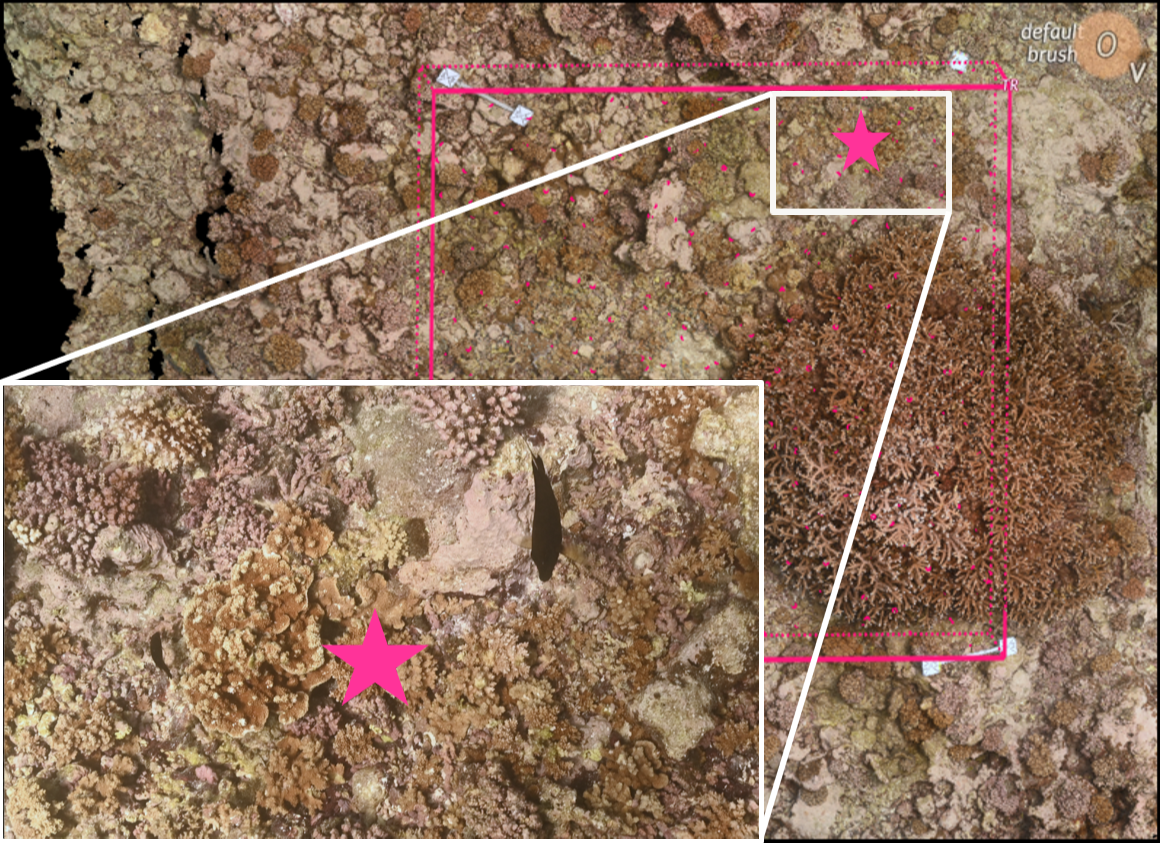
Annual photogrammetry surveys by divers captured ~1,000 images per plot, processed into 3D models using structure-from-motion (SfM) software (Agisoft Metashape).
Benthic composition was quantified using Virtual Point Intercept (VPI) analysis in custom software (Viscore), with ~30 stratified random points per mยฒ identified to the finest possible taxonomic resolution. The pink star indicates a Montipora colony.
Percent cover data were aggregated and standardized across all 13 survey timepoints using a custom Python pipeline, with all visualizations and statistical analyses conducted in R.
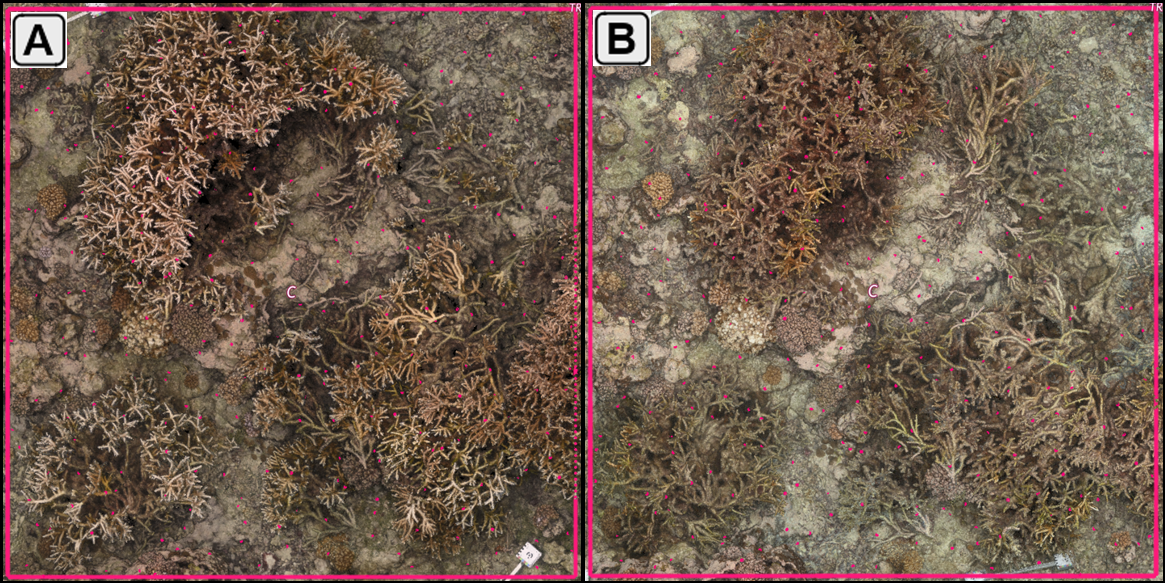
Fifteen permanent plots were established around the shipwreck scar. With the corallimorph gone and the substrate bare, every treatment starts near zero coral cover in October 2015.
Four years in, transplant plots are pulling well ahead. By 2019, all three transplant treatments exceed 15% coral cover while both control plots remain under 3%. This suggests that active restoration, not natural recruitment, is driving recovery.
By October 2023, all three transplant treatments exceed 30% hard coral cover: T-BYSP peaks at 40%, a tenfold increase from the baseline. Control plots reach ~13%, showing passive recovery is possible but slow. There is a distinct gap between active and passive restoration.
The 2023โ2024 global mass bleaching event โ the most severe on record โ begins to take effect on Palmyra. The October 2023 survey captures peak cover. What follows is collapse.
By February 2024, transplant plots crash to ~10% coral cover, while control plots see a lower drop in coral cover. However, two years on, transplant plots remain above controls. This suggests that higher pre-bleaching coral cover may moderate post-bleaching decline.
Select an organism and toggle treatments to compare.
Explore how 11 organism groups changed across treatments over time.